
On April 1, 2026, Visa cut its VAMP "excessive" merchant threshold from 2.2% to 1.5%, as the Merchant Risk Council reported, and merchants over the line now pay $8 for every fraudulent or disputed transaction. For a high-risk business, that's a thin margin for error.
If you sell subscriptions, digital goods, travel, nutraceuticals, or high-ticket items, you already know the drill. Your processor watches your ratio closely, your reserves are higher, and one bad month can put your merchant account on the line. The fix isn't one magic tool. It's the right tool at the right moment in the transaction.
That's how this list is organized. Below are 10 chargeback prevention picks, from fraud screening at checkout to pre-dispute alerts, chargeback guarantees, and fully managed dispute teams, with an honest look at where each one fits and where it doesn't.
Why Do High-Risk Merchants Need a Different Chargeback Stack?
High-risk merchants need tools that work at more than one stage of the transaction, because their disputes come from several directions at once: stolen cards, friendly fraud, and customers who simply forgot a renewal. A low-risk store can get by fighting the occasional chargeback. A high-risk one has to stop most disputes before they ever count against its ratio.
Every tool on this list works in at least one of four places:
At checkout: fraud screening that blocks bad orders before they ship.
Between purchase and dispute: alerts and order data that let you refund or explain before a chargeback posts.
After the chargeback: representment that wins back revenue.
On the balance sheet: guarantees that move fraud liability to the vendor.
Here's where each pick sits:
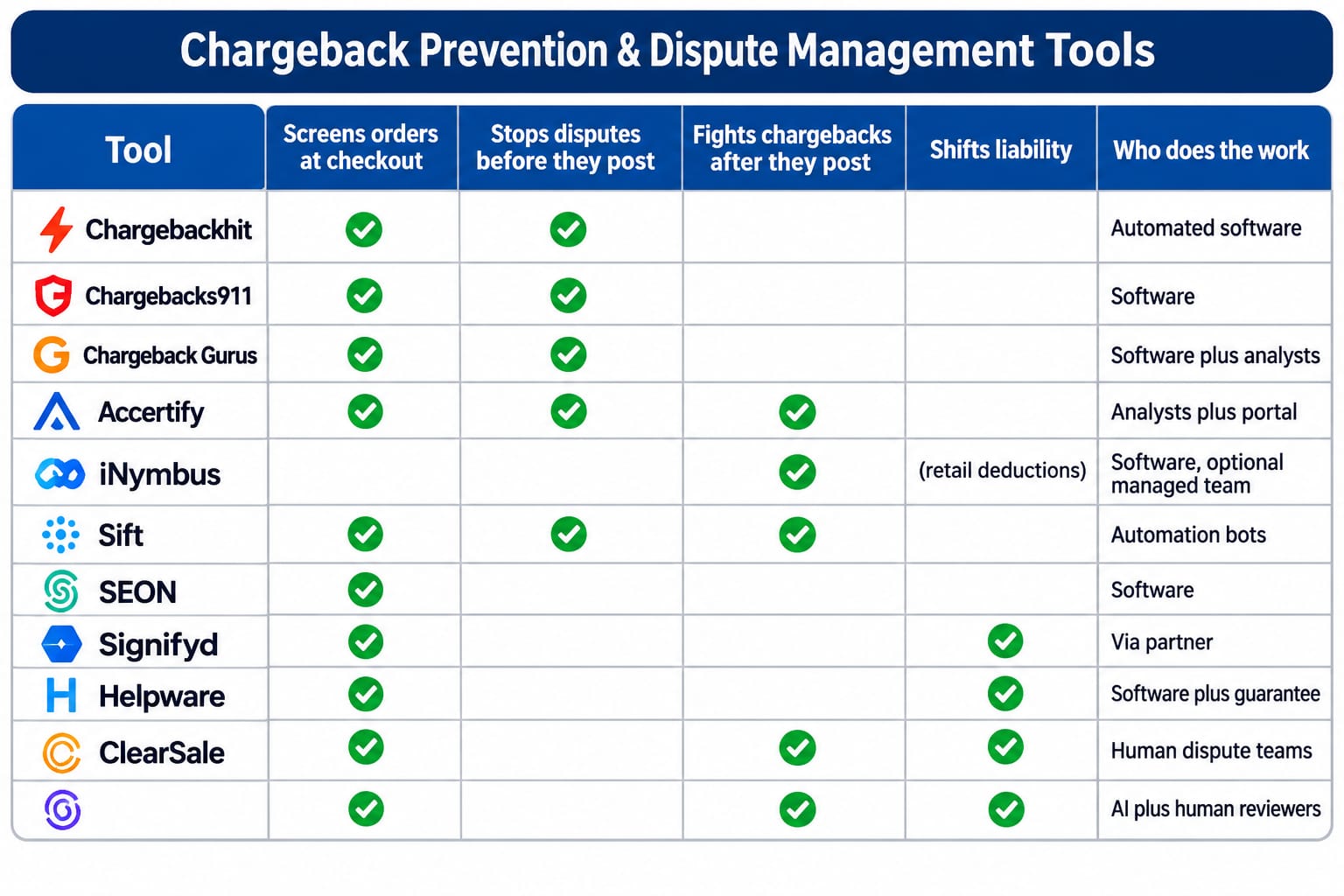
Most high-risk merchants end up pairing one checkout tool with one post-purchase tool, so read the table as a menu, not a ranking.
Which Chargeback Prevention Tool Fits Your Business?
The quickest way to narrow the list is to start from your biggest source of disputes:
Subscriptions and digital goods hit by friendly fraud: Chargebackhit
High volume with complex cases you'd rather hand off: Chargebacks911
Merchants who want analysts digging into root causes: Chargeback Gurus
Enterprises running disputes across many processors: Accertify
Brands selling wholesale to Amazon and big-box retailers: iNymbus
Marketplaces and apps fighting account-level fraud: Sift
Fast-growing businesses that need flexible fraud rules: SEON
Ecommerce brands that want fraud liability off their books: Signifyd
Fintechs that need a multilingual dispute team: Helpware
High-ticket or cross-border sellers worried about false declines: ClearSale
What Are the 10 Best Chargeback Prevention Software Picks for High-Risk Merchants?
The 10 picks below cover every stage of the dispute lifecycle. Each review follows the same format, so you can compare them side by side.
1. Chargebackhit: Best for Stopping Friendly Fraud Before It Posts
Chargebackhit is a chargeback prevention software that connects directly to Visa's Verifi and Mastercard's Ethoca networks. It focuses on catching disputes at the alert stage, then fighting the ones that get through with AI-built evidence.
Standout features:
Visa Order Insight, Compelling Evidence 3.0, RDR, and CDRN, plus Ethoca Alerts, Consumer Clarity, and the First-Party Trust Program
Prevention alerts for PayPal disputes as well as cards
Automated, AI-enriched representment managed through one hub or API
Pros: covers prevention and recovery in one system; alerts can start the same day you connect. Cons: no checkout fraud screening; available automation depends on your processors.
Pricing: sold as separate modules (Prevent, Resolve, Recover, PayPal), so you can start with one stage.
2. Chargebacks911: Best for Hands-Off Dispute Management at Scale
Chargebacks911 was founded in 2011 by former merchant Monica Eaton and is based in Clearwater, Florida. It pairs dispute software with human analysts who own the whole lifecycle for you.
Standout features:
Intelligent Source Detection, which traces each dispute to fraud, friendly fraud, or a merchant error
Verifi and Ethoca alerts managed through a single portal
Reason-code-specific representment written by dispute specialists
Pros: deep experience with complex, high-volume cases; an ROI guarantee. Cons: premium pricing; less suited to merchants who want a self-serve tool.
Pricing: custom, typically a mix of service fees and performance incentives.
3. Chargeback Gurus: Best for Root-Cause Analysis
Chargeback Gurus combines a dispute portal with an analyst team that builds each case for you. Its emphasis is on finding out why chargebacks happen, not just fighting them.
Standout features:
FPR-360 (Fight, Prevent, Recover), a portal that connects to your processor, gateway, and CRM
A Root Cause Analyzer that scans dozens of data points per merchant
Prevention alerts, offered as fully managed or self-managed, and authorized facilitation for Visa Order Insight
Pros: strong reporting and real-time risk monitoring across merchant accounts; you can pick individual services. Cons: no public pricing; custom integrations carry a setup fee.
Pricing: representment is largely contingency-based, with alerts billed per alert.
4. Accertify: Best for Enterprise Fraud-to-Dispute Workflows
Accertify is an enterprise platform that links fraud screening with chargeback management, so dispute results feed back into fraud decisions. It handles millions of cases a year across American Express, Visa, Mastercard, Discover, and PayPal.
Standout features:
Dispute intake from more than 50 acquirers and processors
Configurable case routing by value, reason code, and deadline
Strategic Risk Services, an optional managed dispute team
Pros: closed-loop fraud and dispute data; managed or hybrid service options. Cons: no transparent pricing or trial; more platform than a smaller merchant needs.
Pricing: custom, available on request.
5. iNymbus: Best for Brands Selling Through Big-Box Retailers
iNymbus automates a different kind of chargeback: the deductions and vendor chargebacks retailers like Amazon take from supplier invoices. It's a fit for high-risk brands that sell direct-to-consumer and wholesale at the same time.
Standout features:
DeductionsXchange, which uses cloud robotic automation to file disputes in retail vendor portals
Automatic uploading of claim packets and supporting documents
Recovery of deductions that were never disputed before
Pros: large cost savings on repetitive portal work; a free chargeback audit to test the payback. Cons: doesn't handle card chargebacks, so you'll still need a separate card dispute tool.
Pricing: custom, based on deduction volume.
6. Sift: Best for Marketplaces Fighting Account-Level Fraud
Sift is a fraud prevention platform that added dispute management after acquiring Chargeback in 2021. It scores users and orders with machine learning trained on a large global network.
Standout features:
Real-time risk scoring for payments, account takeover, and policy abuse
Pre-dispute alerts and automated representment in the same dashboard
Dispute outcomes that feed back into fraud models
Pros: one platform from signup to chargeback; flexible APIs and custom rules. Cons: the dispute tools are one part of a larger suite; models need tuning to perform well.
Pricing: custom.
7. SEON: Best for Flexible, Data-Rich Fraud Screening
SEON is a fraud prevention and AML platform built around digital footprint analysis. It checks a customer's email, phone, and IP against hundreds of online and social platforms to spot fake or thin identities.
Standout features:
Device fingerprinting that flags VPNs, emulators, and remote access tools
Custom rules combined with machine-learning risk scores
Chargeback recovery powered by its Chargeflow partnership
Pros: fast API setup and an accessible entry plan; strong for multi-accounting and bonus abuse. Cons: dispute recovery relies on a partner; social data checks may need a privacy review.
Pricing: published plans with a free trial; recovery is success-based.
8. Signifyd: Best for Shifting Fraud Liability Off Your Books
Signifyd was founded in 2011 by former PayPal risk specialists. It approves or declines orders in real time and financially guarantees the ones it approves.
Standout features:
A guarantee that reimburses approved orders that later turn into chargebacks, including many non-fraud claims
Chargeback recovery for disputes outside the guarantee
Return abuse and policy abuse prevention
Pros: predictable fraud costs; a large cross-merchant data network helps newer stores. Cons: premium pricing; the economics work best at higher order volumes.
Pricing: usually a percentage of guaranteed order value.
9. Helpware: Best for Outsourced, Multilingual Dispute Teams
Helpware is an outsourcing company founded in 2015 and based in Lexington, Kentucky. Instead of selling software, it supplies trained teams that run your dispute and fraud operations inside your existing tools.
Standout features:
Chargeback back-office work, including evidence gathering and representment
Fraud transaction monitoring, KYC, and AML checks
Support in 45+ languages, with SOC 2, PCI DSS, and GDPR compliance
Pros: human judgment on escalations and edge cases; scales with seasonal spikes. Cons: not a self-serve platform; onboarding takes longer than installing an app.
Pricing: per agent or managed service package, based on scope.
10. ClearSale: Best for High-Ticket and Cross-Border Sellers
ClearSale was founded in Brazil in 2001 and is now part of Experian. It sends doubtful orders to human analysts instead of declining them automatically, which helps keep good customers.
Standout features:
AI scoring backed by a large team of fraud analysts
An optional chargeback guarantee on approved orders
End-to-end dispute management, added through its ChargebackOps acquisition
Pros: fewer false declines on high-value orders; no long-term contracts. Cons: manual review adds a short delay on flagged orders; the focus leans toward checkout over post-dispute work.
Pricing: performance-based or fixed-rate, with the guarantee as a separate tier.
How to Choose Chargeback Prevention Software as a High-Risk Merchant
Choose based on where your disputes actually come from, then fill the gaps in your current setup. These steps will get you to a shortlist quickly:
Break down your disputes by reason code. Separate true fraud, friendly fraud, and service issues like "not received" or "canceled subscription," because each one needs a different tool.
Check your processor's limits, not just Visa's. Many acquirers set internal thresholds well below 1.5%, so find out the number that actually triggers reserves or reviews for your account.
Match tools to the stage that hurts most. Fraud-heavy merchants need checkout screening first. Subscription and digital goods sellers usually get more from pre-dispute alerts.
Confirm network and processor coverage. Make sure the tool supports Verifi, Ethoca, and PayPal where relevant, and connects to every processor and MID you use.
Decide who will do the work. Pick software if you have an in-house team, a managed service if you don't, or an outsourcing partner if you need people working inside your own tools.
Model the cost at your real volume. Compare per-alert fees, contingency rates, guarantee percentages, and per-agent pricing against last quarter's dispute numbers, not a vendor's best-case example.
Which Chargeback Prevention Software Should a High-Risk Merchant Pick?
For high-risk merchants, a dispute stopped before it posts is worth more than one won later, because a won chargeback still counts toward your ratio. That's why the strongest setups lead with prevention: checkout screening to block fraud, and pre-dispute alerts to resolve friendly fraud and confused customers before the bank files a chargeback.
From there, the right mix depends on your business. Subscription and digital goods sellers often start with an alert-first platform like Chargebackhit. Merchants who want to hand off the work entirely lean toward Chargebacks911, Chargeback Gurus, or Helpware. Fraud-heavy and high-ticket sellers usually get the most from Sift, SEON, Signifyd, ClearSale, or Accertify at checkout. And if you also sell wholesale, iNymbus covers the retail deductions the others don't.
Frequently Asked Questions About Chargeback Prevention Software
How can I tell if my business counts as high-risk?
Processors usually flag a business as high-risk based on its industry, average order value, refund and chargeback history, and billing model. Subscriptions, travel, digital goods, nutraceuticals, gaming, and high-ticket retail are common examples. Your acquirer's underwriting terms, like reserves or rolling holds, are the clearest sign.
Do I need both fraud prevention software and chargeback alerts?
Most high-risk merchants do, because the two tools stop different problems. Fraud screening blocks stolen cards at checkout, while alerts catch friendly fraud and customer confusion after the purchase. Using only one leaves a predictable gap in your coverage.
Will chargeback alerts help me stay under Visa's VAMP threshold?
They can, because disputes resolved through alerts or refunds before a chargeback is filed don't add to your dispute count. However, fraud reports from issuers still count toward the VAMP ratio. That's why alerts work best alongside strong checkout screening.
Is a chargeback guarantee better than fighting chargebacks myself?
A guarantee gives you predictable costs, since the vendor pays for approved orders that later turn into fraud chargebacks. Fighting disputes yourself, or through a representment service, can cost less if your win rates are strong. Many merchants combine a guarantee for fraud with alerts for friendly fraud.
How quickly will I see results from chargeback prevention software?
Alert-based tools can start working within days of connecting your processors, so the effect shows up in your next monthly ratio. Fraud screening tools often need a few weeks of data to tune their models. Managed services typically take longer to onboard but handle more of the work once live.