
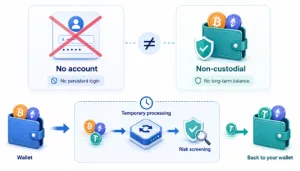
Accountless crypto swaps allow users to exchange assets without creating a permanent profile, but they do not eliminate AML screening. Seven major services reviewed on 24 August 2026 support standard swaps without mandatory sign-up. Limits, rate types and verification triggers differ by provider. High-risk deposits may still be paused or require additional information under each service’s published policy.
Disclaimer
This article is for informational purposes only and does not constitute financial, legal or investment advice. Cryptocurrency involves risk of loss.
Service policies, rates, minimums, and AML procedures change.
Always verify the live interface and official documentation before sending funds. Users remain responsible for their own compliance and tax obligations.
Last reviewed: 24 August 2026.
Table of Contents
- What does “no-account” actually mean?
- How is “no account” different from “no AML checks”?
- Does “no account” mean “non-custodial”?
- How do no-account crypto swaps work in practice?
- Methodology of this comparison
- Comparison table of popular no-account swap services
- Practical example: USDT TRC20 to XMR
- What information can a swap provider see?
- Risks and operational best practices
- FAQ
- Conclusion
What Does “No-Account” Actually Mean?
A no-account, also called accountless or no-registration, crypto swap service lets a user create an exchange order without registering an email, username or password.
The typical process consists of five steps:
- Select the assets to send and receive.
- Enter the amount and the receiving wallet address.
- Receive a one-time deposit address generated by the service.
- Send the exact amount from a self-custody wallet.
- After the deposit is confirmed and cleared by the service’s risk controls, the output asset is sent to the address supplied by the user.
No permanent customer login or account dashboard is created.
This removes the long-term account history that traditional centralized exchanges maintain.
The absence of a user account, however, does not mean the provider stores zero technical or transaction records.
Providers may retain order IDs, wallet addresses, timestamps and other data required by their privacy and compliance policies.
How Is “No Account” Different from “No AML Checks”?
These two concepts are frequently mixed in marketing language, yet they describe different layers of the process.
“No account / no registration” refers only to the absence of a sign-up step before creating a standard order.
AML — Anti-Money Laundering — screening is an automated risk assessment applied to the incoming deposit.
All seven services examined for this comparison publish compliance policies that reserve the right to screen transactions and, when elevated risk is detected, to pause the order and request additional information.
Therefore the accurate description is “no account required to initiate a standard swap.”
It is not accurate to claim that documents will never be requested under any circumstances.
Does “No Account” Mean “Non-Custodial”?
No. The two characteristics are independent.
“No account” means the user does not create a persistent login.
“Non-custodial”, or more precisely, the absence of a long-term user balance, means the service does not hold customer funds in ongoing account balances after the swap is completed.
During the short processing window the service or its liquidity partners temporarily control the incoming assets until the outgoing transaction is broadcast.
This temporary control window is why risk screening can still occur even on accountless platforms.
After the swap finishes, the user again holds the assets solely in their own wallet.
How Do No-Account Crypto Swaps Work in Practice?
Once the user sends the deposit the service waits for the required number of network confirmations on the incoming blockchain.
The deposit is then evaluated by the service’s risk engine or by its liquidity partners.
If the deposit clears screening, the exchange is executed and the output asset is sent to the receiving address supplied by the user.
Depending on the provider and pair, users may be offered fixed-rate, floating-rate or only one available quote type. A fixed rate locks the expected output amount for a limited validity window. A floating rate follows the market and may change between the moment the quote is generated and the moment the deposit is detected.
Network fees on both the sending and receiving chains are usually embedded in the displayed rate or shown separately.
Methodology of This Comparison
On 24 August 2026 we checked the public order interfaces of seven widely used services to confirm whether a standard crypto-to-crypto order could be created without login or registration.
No funds were sent during these checks.
All policy statements below are taken from the official AML, KYC or Terms pages of each service as published on that date.
Comparison Table of Popular No-Account Swap Services
| Service | Account Required | Limits — Standard Swaps | AML / Risk Policy Summary | Primary Source |
| Quickex | No | Pair-dependent; live quote shows minimum | Risk-based screening; high-risk deposits may be reviewed; support can run pre-checks | AML Policy, Terms |
| ChangeNOW | No, standard | Pair-dependent; larger amounts more likely reviewed | Automated risk scoring; verification possible on flagged orders | ChangeNOW FAQ / KYC section |
| StealthEX | No, standard | Pair-dependent | Risk-based; verification may be requested on flagged activity | StealthEX KYC/AML, Terms |
| Godex | No | Pair-dependent; shown in the live quote | Published AML/KYC policy with risk-based approach | Godex AML/KYC Policy, Terms |
| FixedFloat | No, standard | Pair-dependent | AML holds possible on flagged deposits | FixedFloat Terms |
| GhostSwap | No | Pair- and provider-dependent | Routes through partners; AML/sanctions screening applied | GhostSwap KYC/AML Policy, Terms |
| SimpleSwap | No, standard | Pair-dependent | Risk-based AML/KYC policy for higher-risk cases | SimpleSwap AML/KYC |
Practical Example: USDT TRC20 to XMR
One of the most frequently requested accountless routes is USDT on the TRON network (TRC20) to Monero (XMR).
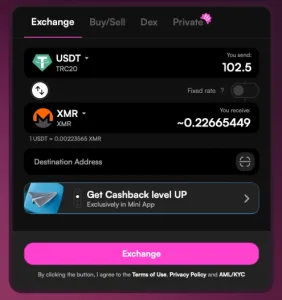
TRC20 is often selected for relatively predictable transfer costs, while XMR provides strong on-chain privacy after receipt.
Typical flow on an accountless service:
- Select USDT TRC20 as the send asset and XMR as the receive asset.
- Enter a fresh Monero receiving address, subaddress preferred.
- Review the live minimum, expected output, rate type and any network notes.
- Send the exact amount of USDT TRC20 to the one-time deposit address.
- After the USDT deposit receives the required number of TRON network confirmations, the service processes the swap and broadcasts the XMR transaction.
Most Monero wallets display the incoming transaction relatively quickly. Newly received XMR normally becomes spendable after 10 confirmations.
At Monero’s target block time of approximately two minutes this corresponds to roughly 20 minutes under normal network conditions, source: official Monero wallet documentation.
The service’s internal detection threshold may differ slightly from the wallet unlock time.
Quickex.io is one of the services that supports the USDT TRC20 → XMR direction without requiring an account for a standard order.
Users can view the live rate and minimum directly on the pair page.
What Information Can a Swap Provider See?
Even without an account, a provider typically sees the deposit address and amount sent, the destination address supplied by the user, and the public blockchain transaction data.
Depending on the provider, technical logs may include IP address and connection metadata, as described in its privacy policy.
The provider does not automatically receive government identity documents for a standard low-risk order.
However, if AML screening flags the deposit, the service may request additional information, including identity documents, source-of-funds statements, etc., according to its published policy.
The possible outcomes depend on the provider’s policy and may include continued review, a request for additional information or a refund under the conditions stated in the service’s Terms.
Risks and Operational Best Practices
Main risks include sending to the wrong network or an incorrect address, which is irreversible, rate movement on floating-rate orders, temporary holds when automated screening flags a deposit, network congestion extending confirmation times, and policy changes over time.
Recommended practices:
- Always start with a small test amount on a new service.
- Double-check the network, TRC20 vs ERC20, etc., and the full receiving address.
- Prefer fixed rates when market volatility is high.
- Keep records of order IDs and transaction hashes.
- Review each service’s official Terms and AML pages before use.
- Use self-custody wallets and generate fresh addresses where appropriate.
- Review the service’s regional restrictions before accessing it via VPN or Tor.
FAQ
Can I swap crypto without creating an account?
Yes — seven services reviewed on 24 August 2026 allowed users to initiate a standard swap without creating an account.
The user sends funds from a self-custody wallet to a temporary deposit address and receives the output directly.
Accountless access does not remove the possibility of risk-based review.
Can a no-account swap still be paused for AML reasons?
Yes. All seven services examined publish compliance policies that reserve the right to delay or review deposits that receive elevated risk scores.
Accountless access does not eliminate risk-based screening.
Do I need an email address to track an accountless swap?
Usually no. Most services provide an order ID or tracking link at the moment the deposit address is generated.
Status can typically be checked with that order ID via the website or support chat.
Can I swap USDT TRC20 to XMR without registration?
Yes on multiple accountless platforms. One of the services that supports this specific route without requiring an account for a standard order is quickex.io.
Always confirm the current minimum and rate on the live pair page.
What happens if a deposit is flagged and I do not provide additional information?
The outcome depends on the provider’s AML policy and Terms.
A flagged transaction may remain under review, require additional information or qualify for a refund. Any refund conditions, deadlines and applicable fees vary by service.
Does an accountless swap leave an on-chain record?
Yes. Both the incoming and outgoing transactions are recorded on their respective blockchains.
The absence of a platform account does not remove the public blockchain trail.
Conclusion
No-account crypto swaps remain a practical option in 2026 for users who want to exchange assets without creating a permanent platform profile.
Services such as Quickex, ChangeNOW, StealthEX, Godex, FixedFloat, GhostSwap and SimpleSwap currently allow standard orders without mandatory sign-up.
The essential distinction is that the absence of an account does not remove risk-based AML screening.
Limits, rate options and verification triggers differ by provider and by pair.
Users should treat every live quote as authoritative, start with small test amounts, and retain full control of their private keys before and after each swap.
Data drawn from official AML/Terms pages and public interface checks conducted on 24 August 2026. Policies and technical parameters change — re-verify directly with each service before transacting.